Locally grown Sphaxx takes over Opti-flor
In commercial horticulture, the search for sustainable and reliable growing media is more important than ever. Greater supply security, consistent quality, and reduced pressure on natural ecosystems are all playing a significant role. Sphaxx from Klasmann-Deilmann is a solution to these issues.
The orchid grower Opti-flor is one of the major users of Sphaxx. Here, Ruud Duijvestijn, Head of Cultivation and Energy at Opti-flor, shares his experiences.
“When we first came across Klasmann-Deilmann’s greenhouse-grown sphagnum about five years ago, we were actually still in an exploratory phase,” explains Ruud Duijvestijn. “We had already been working with compressed peatmoss sheets from the southern hemisphere for a number of years. However, we were faced with delivery times of three months and inconsistent quality. So we did see potential in a locally grown alternative, provided it could match what we were used to.”
From small-scale trial to significant volumes
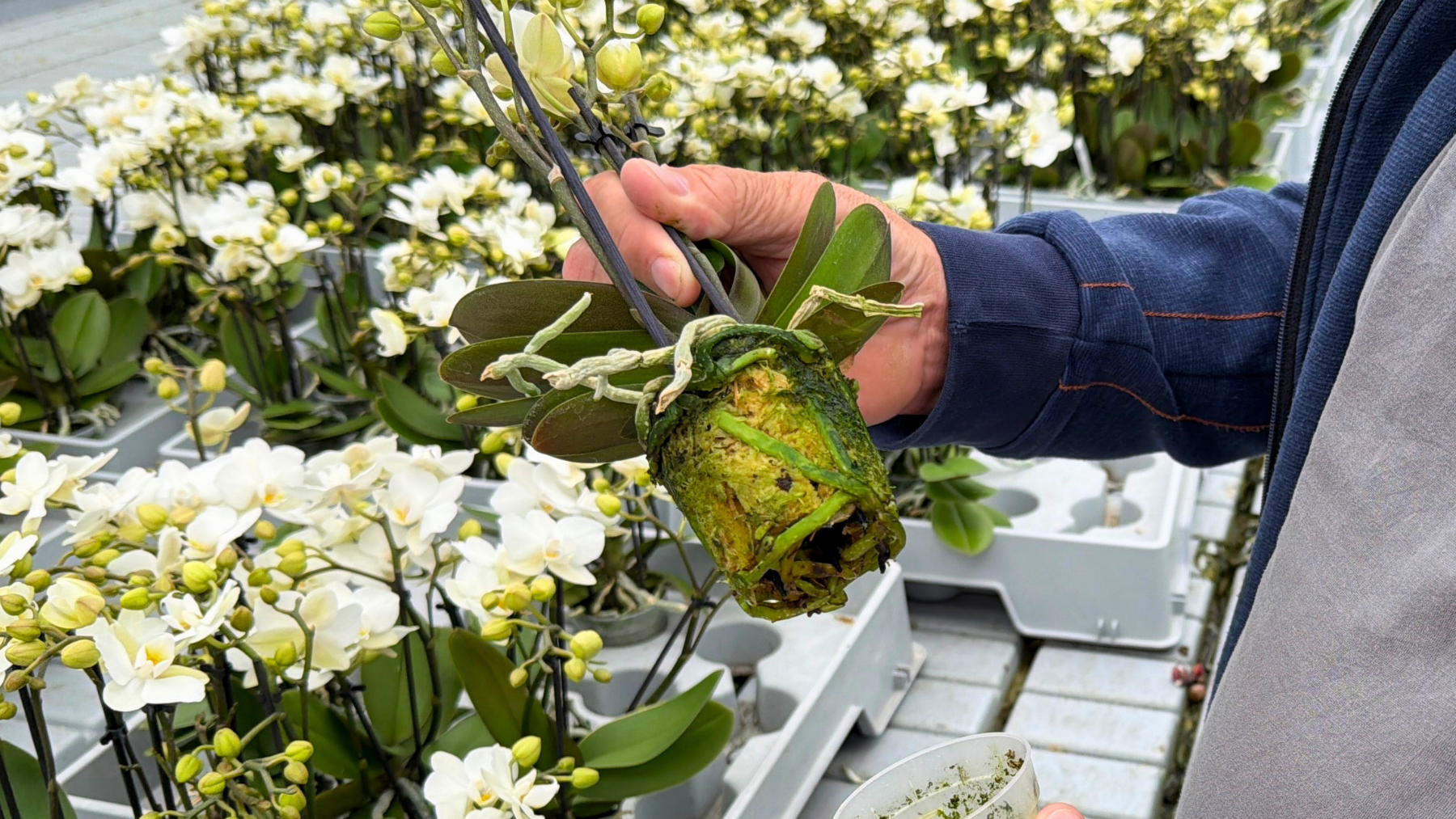
The initial steps were taken with caution, beginning with small-scale trials before moving on to larger-scale production. „We started with a pilot of 48 plants in 7 cm pots, maintaining strict confidentiality. We monitored these closely together with Klasmann-Deilmann. The results exceeded expectations, and from that moment on, we began scaling up step by step. The volume of purchases has since grown into a significant production stream. We now use Sphaxx in around 15,000 pots per week.“
According to Ruud Duijvestijn, mutual trust was key from the outset. “Trust is something you build together. By continuously testing, evaluating, and making adjustments, we got to know the product better and better. Close collaboration and short lines of communication make all the difference.”
Consistent quality and direct lines of communication
The consistent, pure quality strikes him most of all. “The Sphaxx is grown by Klasmann-Deilmann under controlled conditions, which makes it cleaner. As irradiation is required for imported trays, it is not necessary here. Sphaxx owns greater biodiversity and it is free from weeds.”
He continues: „What’s more, the seedlings are very uniform. That’s hugely important in practice. It means we can predict the growing results more easily. If anything comes up, we can quickly liaise with Klasmann-Deilmann. Their proximity is a real advantage.”
Resilient and adaptable
Supply reliability also plays an important role. “With overseas products, it can easily take three months for your order to arrive. That makes your value chain vulnerable. With a local supply chain, that risk is much smaller. You know where the products come from, and you can anticipate things more quickly. This provides peace of mind when planning and ensures business operations run smoothly.”
Moreover, Ruud Duijvestijn also recognises clear sustainability benefits. “Sphagnum from pristine peatlands is around 40 years old by the time it is harvested. In contrast, Klasmann-Deilmann’s sphagnum is ready for harvest within a year as it is a cold-climate crop. That, too, is innovative, and I think it’s really impressive. For us, that is the future: a combination of quality, innovation, supply security, and nature conservation.”
Author: Anita Bassie