TerraCoal® – making climate targets achievable for horticultural businesses
Today, the professional horticultural sector faces increasingly complex market expectations. Starting in Europe, pressure is also growing internationally to reduce peat consumption and improve the climate impact of production. Retailers and other players in the supply chain are increasingly demanding robust data and credible concepts for lower-emission production. At the same time, the requirement for reliable crop management remains.
This is precisely where Klasmann-Deilmann’s new TerraCoal biochar comes in. It has been specifically developed to offer horticultural businesses a practical solution to the growing demands regarding climate impact, peat reduction and credible sustainability communication. TerraCoal supports modern substrate formulations, can directly reduce the carbon footprint there and thus opens up a new way of presenting sustainability along the value chain in a traceable and certifiable manner.
TerraCoal makes the substrate part of the solution
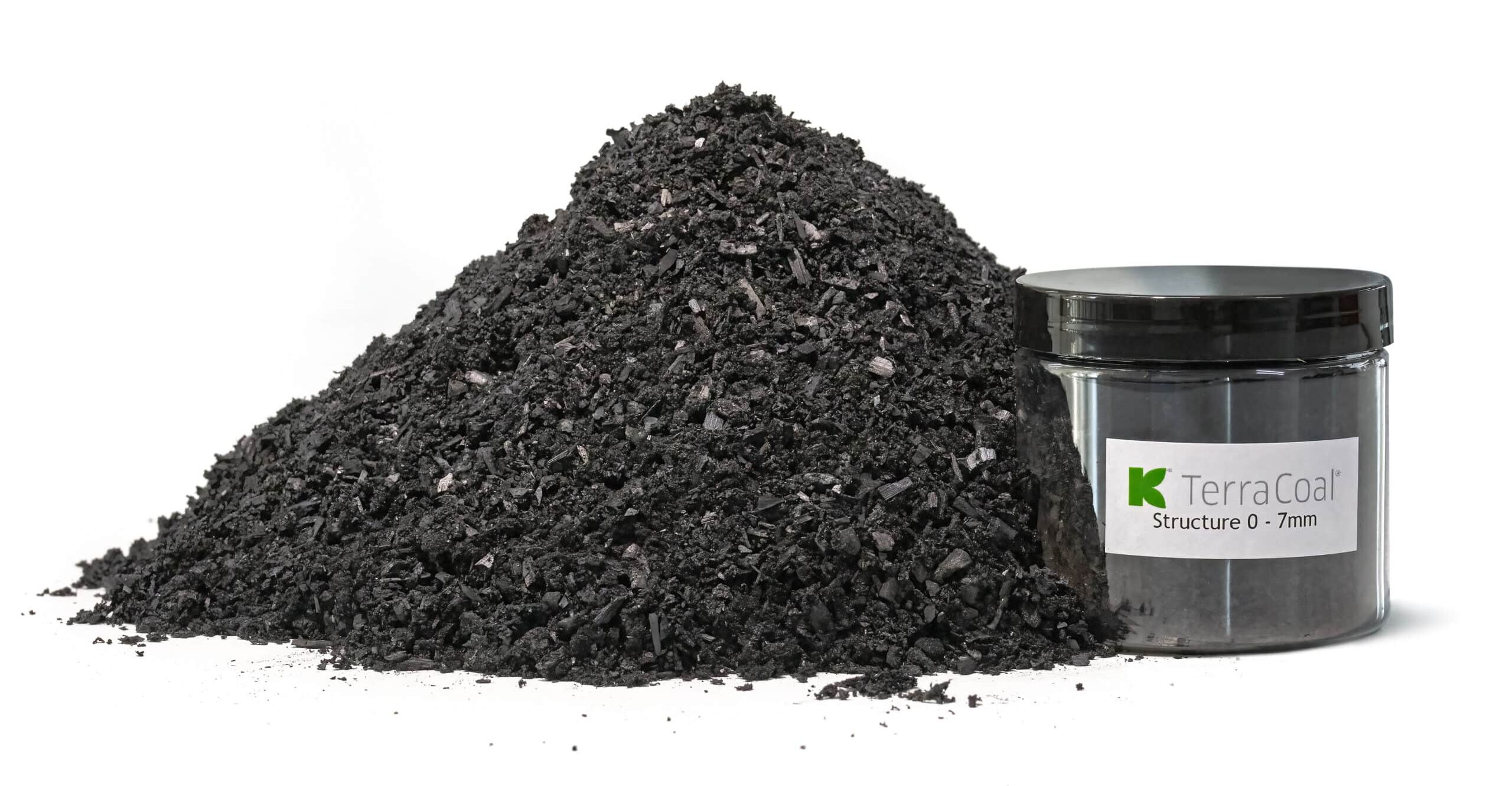
TerraCoal is based on the idea of rethinking carbon. Not just as a source of CO2 emissions, but also as a horticultural resource. The biochar is produced from organic raw materials using an innovative pyrolysis process, stores carbon long-term and thus forms a CO2 sink. As a result, it can help to offset emissions from other substrate constituents in growing media and specifically improve the carbon footprint of plant cultivation.
“With TerraCoal, we are, for the first time, consistently pursuing an approach that not only reduces CO₂ but also specifically stores and offsets it within the substrate. This represents a genuine shift in perspective for professional horticulture,” says Dr Sebastian Kipp, Director Innovation at Klasmann-Deilmann.
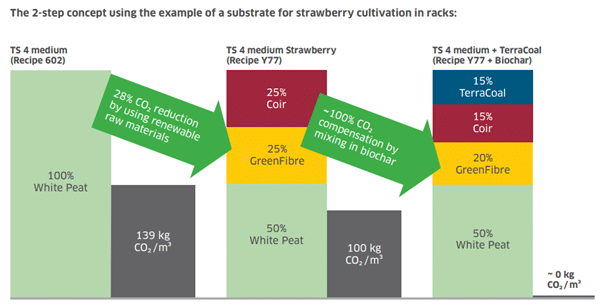
This approach is particularly relevant as substrates can account for a significant proportion of a crop’s carbon footprint. An example from strawberry cultivation shows that a purely peat-based substrate accounts for 139 kg of CO₂ equivalents per cubic metre of substrate. A peat-reduced concept using wood fibre and coir, on the other hand, stands at 100 kg CO₂ eq/m³, and only a formulation supplemented with TerraCoal can be steered towards net zero.
Benefits to crops become evident during cultivation
However important the climate impact may be, in horticulture it is ultimately the practical suitability that counts. New substrate components must prove themselves in cultivation. This is precisely where TerraCoal demonstrates a profile that is of interest to many growers. In R&D trials with Dieffenbachia and Calathea, plants in substrates containing 10% TerraCoal developed very well. Uniform root development, consistently strong growth and intense leaf colouration were observed. At the same time, the formulations exhibited more stable pH patterns, particularly in peat-free cultivation. This is an important aspect for a reliable nutrient supply and thus crop reliability, especially with sensitive crops.
“Particularly in peat-free or strongly peat-reduced mixtures, we see that TerraCoal can act as a stabilising factor. This is of interest to many growers because climate targets and cultivation requirements cannot be separated anymore from one another,” explains Anja Fritzen, technical advisor at Klasmann-Deilmann.
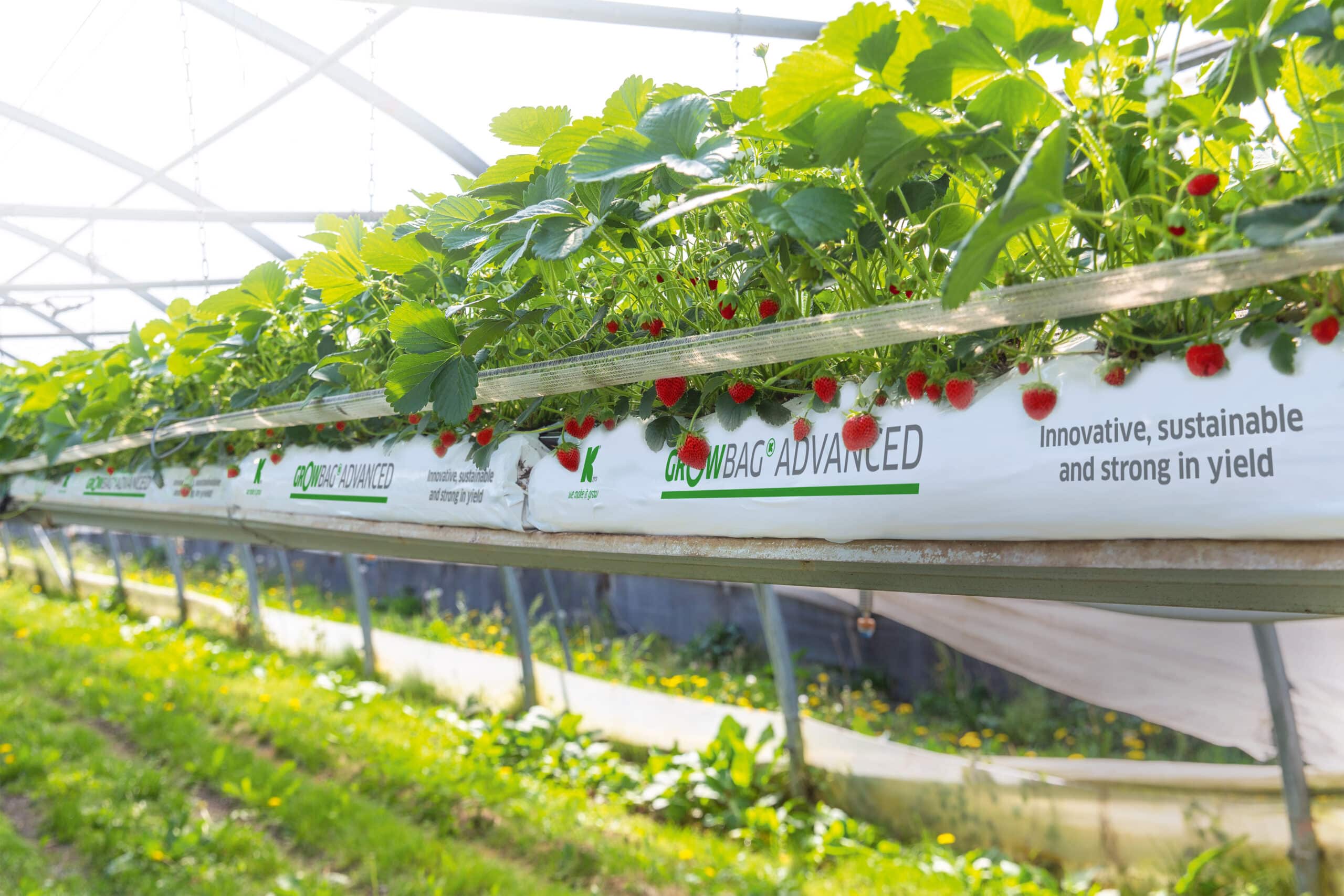
As peat content is reduced, the challenges in crop management also increase. Water retention, air capacity, pH stability and nutrient availability must be balanced even more precisely in many crops. TerraCoal can make an additional functional contribution here. The biochar provides structural stability, supports water and air circulation in the root zone, buffers important nutrients and also promotes microbial activity. This makes the innovative TerraCoal biochar attractive for various applications, such as emission-optimised peat-free or peat-reduced pot and container substrates, as well as in propagation. The CO2-reduced cultivation of fruit vegetables and strawberries in growbags is also a key area for the use of TerraCoal.
Sustainability requires verifiability
For many nurseries, the issue of sustainability only becomes relevant when they have to demonstrate it to customers, auditors or trading partners. This is precisely why it is often no longer sufficient today to simply produce plants peat-reduced. What is required is traceable data, reliable facts and certificates.
This is where TerraCoal offers added value. The CO₂ certificate available for TerraCoal helps to document the substrate’s climate impact. This contribution may become relevant in the future within the corporate carbon footprint of horticultural businesses. Klasmann-Deilmann acts as a service provider for all aspects of issuing and decommissioning CO2 certificates.
A new selling point for retailers
Sustainability in horticulture does not end with the cultivation process, but must above all be communicated effectively to the end customer. Today, many decisions in the retail sector are no longer made solely on the basis of quality and price, as credible sustainability is becoming increasingly important. TerraCoal creates a simple and transparent product benefit for this purpose. The plants grow in a substrate that acts as a carbon sink, thereby becoming part of an active climate strategy for the end customer as well. This advantage combines high-quality plants with a clear added benefit in the market. In dialogue with the customer at the point of sale, this can make a significant difference.