The Art of Hydrangea Cultivation
Horticulture Guido Sonneville masters the Art of Timing and Substrate
Behind the spectacular bloom of a hydrangea lies a meticulous process shaped by generations of horticultural knowledge, careful substrate choices and precise planning. At Horticulture Guido Sonneville in Destelbergen, Belgium, these plants spend up to eight months in cold storage—an invisible but crucial phase in their development. This story takes you into a world where roots matter more than flowers, and success is measured in subtle variations of soil and timing.
Five thousand carts of plants disappear into cold storage in November. They endure up to eight months of cold temperatures, as delivery to the forcing facility continues until June of the following year. Between those two moments lies a story of experience, precision, patience—and just the right substrate.
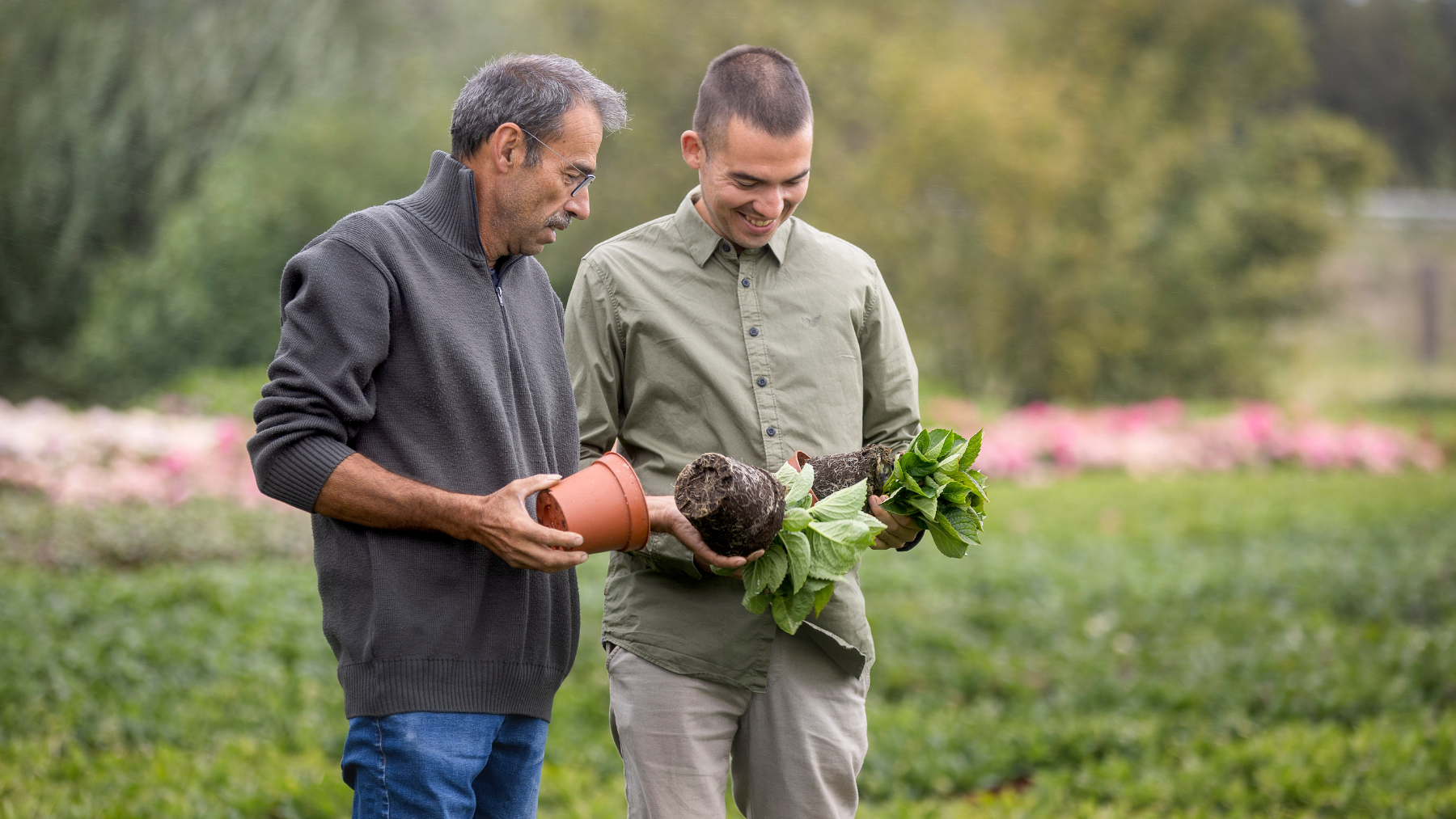
Guido Sonneville (61) walks between the rows of hydrangeas in Destelbergen. Together with his wife Rita (62) and son Thomas (30), they run a business now in its fourth generation. “My grandfather started the business after the First World War. He watered everything by hand and delivered plants in Merelbeke with a dog cart. Today, we produce one and a half million hydrangeas per year and export them across Europe and beyond.”
This scale-up demands precision at every level. The substrate, in particular, plays a key role when plants are stored for months without a drop of water.
Different Soils, Different Roots
“We use different substrates because we grow in different ways,” Guido explains during a tour. “Plants in container fields with foil grow differently than those in pots on open ground. In the sandy soil around Destelbergen, hydrangeas develop a thicker root system. That sandy soil gives them a little extra. When we grow in container fields, we need to compensate for the lack of sandy soil by adapting the substrate.”
Bart Claessens from Klasmann-Deilmann adds: “In open ground, sandy soil draws moisture from the pot base. In container fields, fine and heavy substrates can cause oxygen deficiency at the roots. A lighter mix is better here.” The Sonneville family tests new substrates actively. “In recent years, we’ve run trials with peat-free substrates. Keeping all other variables constant, the differences become clear—both in colour and in leaf quality.”
Bart agrees: “You can spot the dividing line instantly. Plants in heavier, compost-rich mixes are darker. It’s a vivid example of how hydrangeas respond to substrate composition—and how cultivation changes entirely with just one variation.”
Collaboration Since 2003
The search for the perfect substrate brought Guido to Klasmann-Deilmann in 2003. “Over the years, we’ve tested many combinations. Adjusting the mix with more or less white peat, more or less clay—it’s a continuous process of fine-tuning.” Bart adds: “Guido and Thomas use a rather unique mix compared to others—lots of compost and loamy clay. It’s quite traditional and suits hydrangeas well.”
Guido explains: “Hydrangeas grow large and tall, so we need stability in the pot. The substrate must hold moisture throughout the cooling period.” Bart continues: “The last plants of a season can spend eight months in cold storage—no leaves, no evaporation. If the substrate dries out, root tips will be damaged. We need a structure that holds moisture long-term. That’s the challenge.”
From Pink to Blue
Hydrangeas are known for their striking colours, and that’s no accident. Guido points to a field: “We’re ‘bluing’ these plants by changing the soil’s pH—not through the substrate, but by adding aluminium sulphate to the water. It’s how we turn pink to blue. White stays white, and red stays red.”
“But the plant leaves here without flowers,” adds Thomas Sonneville with a smile. “What matters most is the root system. The fewer flowers at this stage, the better.” It may sound counterintuitive, but the flower buds are already visible in autumn—if you know where to look.
Timing is Everything
The root system is crucial because hydrangeas are incredibly timing-sensitive. It takes nearly two years to grow from a cutting in February to a blooming plant, but there’s just a one-month window to ensure optimal branching. “Between 15 June and 15 July, we top all the plants,” Guido explains. “This creates a beautiful, full shape. Some varieties are topped once, others twice, but after that, there’s no more structural adjustment possible.”
Cooling must be just as precise. “Hydrangeas need at least 40 days of cooling—about 1,000 hours. This can occur naturally or in refrigerated storage. We prefer to control it. From October, they go into the refrigerator, where we add ethylene gas to trigger leaf fall. The result looks like a tiny Christmas tree without needles.”
From there, the international market takes over. “Scandinavia prefers compact varieties because of high energy costs. In Turkey, size matters—they like mass and volume.”
Back to Basics
While peat-free alternatives are gaining attention, Guido reflects on the past. “My grandfather made his own substrate: azalea soil, cotton, and manure, layered and rested over winter. But those were different times. He also watered everything by hand!”
Today, the family continues to experiment with innovations like Growcoon. “Anything that strengthens the root system is worth exploring.” Thomas, representing the fourth generation, sees this blend of old and new as essential. “We have loyal customers who trust our knowledge. But that doesn’t mean we can stand still. We always have to think ahead.”
That foresight is measured in years, not months. “It takes two years for decisions about substrate or cuttings to show up in flowers,” says Guido. “So we watch market trends and plan ahead. But we’ve learned one thing: healthy roots in the right substrate are always the key.”