Scaling up biochar: the role horticulture can play
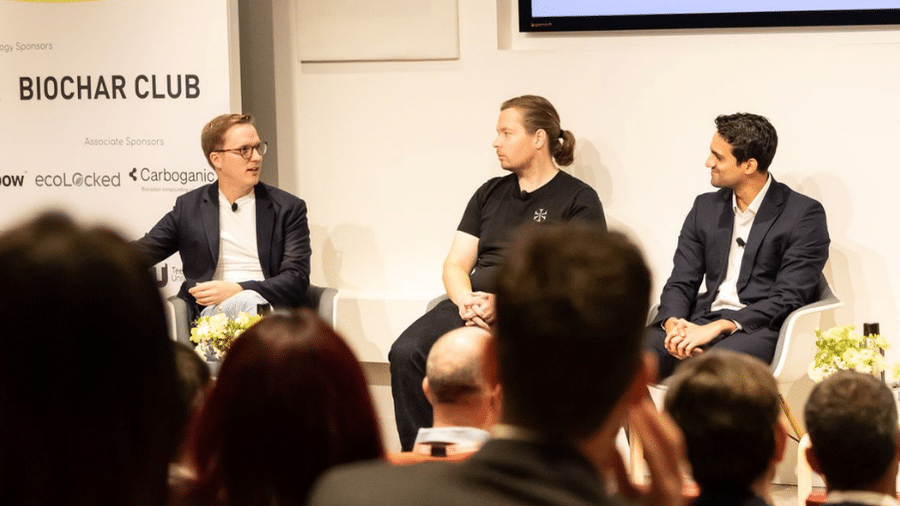
Klasmann-Deilmann at the Global Biochar Commercialisation Summit in London
In early March 2026, experts from industry, technology, finance and academia from around the world gathered in London for the inaugural Global Biochar Commercialisation Summit. The aim of this first-ever conference was to find ways to scale up the production and application of biochar worldwide.
Dr Sebastian Kipp represented Klasmann-Deilmann at the event and participated in the opening panel discussion about the conditions that companies need to meet in order to use biochar on a larger scale.
Biochar as a building block for permanent carbon sequestration
Biochar is considered a promising technology for the permanent sequestration of carbon. While many climate strategies focus on reducing emissions, biochar enables CO₂ to be removed from the atmosphere over the long term.
However, scaling up this technology is complex. The value chain involves numerous stakeholders, including biochar producers, energy companies, project developers, and buyers of CO₂ certificates.
The crucial factor is ensuring that the biochar actually ends up in a permanent carbon sink. Only when this condition is met can CO₂ certificates be generated and traded.
Horticulture as a previously underestimated player
Biochar is primarily considered in the context of agriculture in many discussions. Professional horticulture has played a much smaller role in industry perception to date. This is precisely the area in which Klasmann-Deilmann brought a new perspective to the summit.
„We are one of the few companies that can actually use biochar functionally, namely as a component of growing media,“ explains Sebastian Kipp. „Through our value chain, the biochar ultimately ends up in the soil, where it is bound for the long term.“
Great interest among potential customers
The perspective of an industrial user was met with great interest by the summit participants. “After we explained the quantities that could theoretically be used via substrates, there was a great deal of interest,” reports Sebastian Kipp. Numerous discussions with producers and project developers revealed that reliable off-takers are essential for establishing new production capacities.
Raw materials and global supply chains
Another key topic at the conference was identifying suitable biogenic raw materials for producing biochar. Although wood chips are currently commonly used, they are comparatively expensive.
Consequently, there has been an increase in discussion about the use of biogenic residues that have not been widely used to date. Large quantities of this type of biomass are available, particularly in regions such as Africa and India. Making greater use of these resources could reduce production costs in the long term and facilitate the development of new international production structures.
Prospects for use in growing media
Klasmann-Deilmann is working to expand the use of biochar in growing media even further. Trials are currently underway using larger quantities of TerraCoal in growing media for young vegetable plants. At the same time, the supplier network is being expanded to establish stable, regional supply chains in the long term wherever possible.
Discussions in London revealed that horticulture could play a significant role in the future biochar value chain. Using it in growing media establishes a link between biochar production and agricultural application, providing an additional method of long-term carbon sequestration.