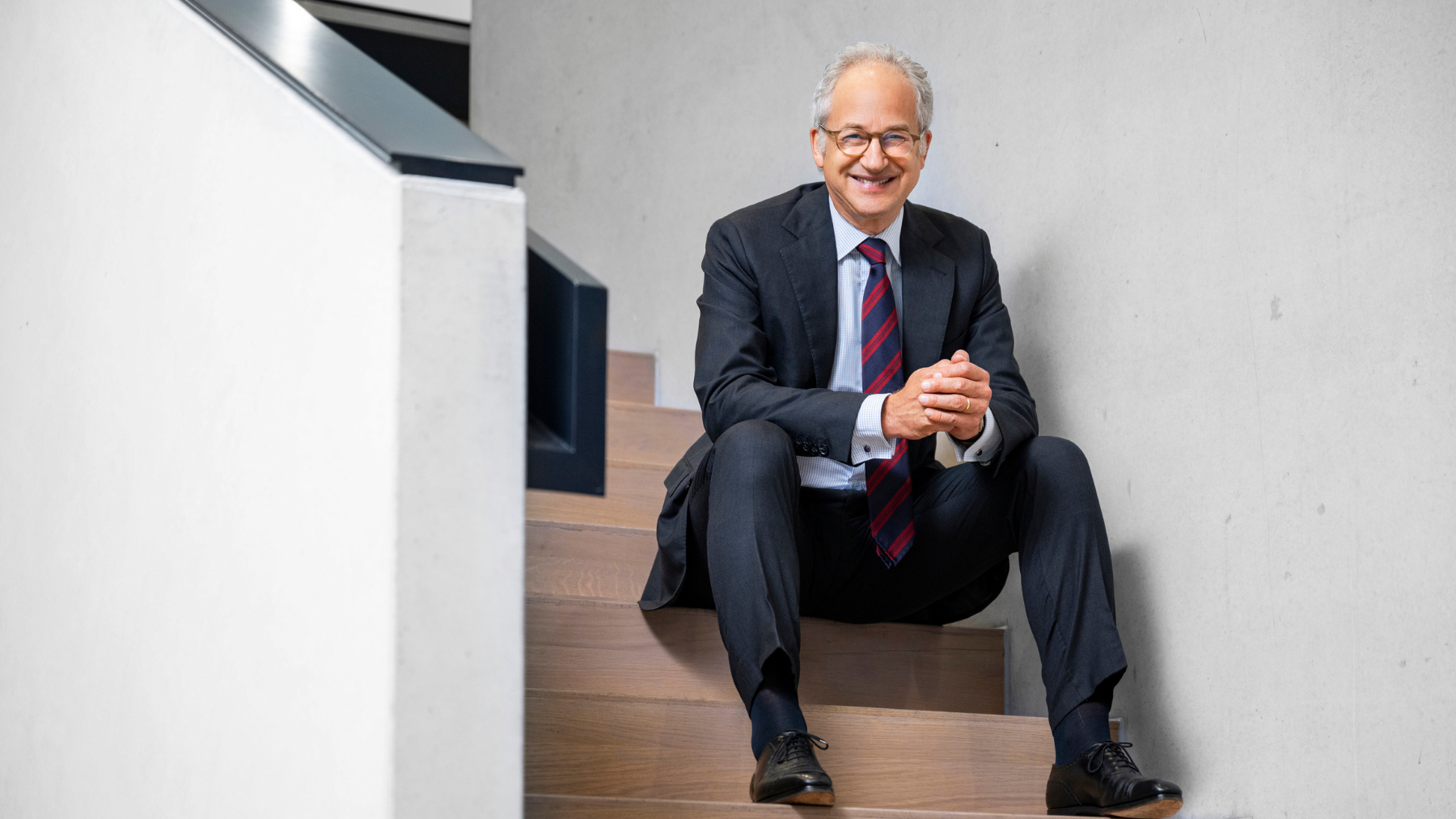
Moritz Böcking: We delivered!
Renewable resources quota increases | Successful launch for Sphaxx® and TerraCoal®
Moritz Böcking, Managing Director of the Klasmann-Deilmann Group, answers questions from TASPO about current developments in commercial horticulture. His interview partners are Matthias Pioro, the new Managing Director of Haymarket Germany, and the outgoing Haymarket Managing Director Uwe Schütt.
Matthias Pioro: Mr Böcking, let’s start with the current situation regarding peat reduction. End customers are not really on board with peat reduction, and perhaps horticultural businesses will not be either at some point. What does this mean for future developments in your view?
Moritz Böcking: Horticultural businesses and end customers focus their attention on the plant. It must develop healthily, look attractive and, in the case of fruit and vegetables, taste good and be healthy. Politicians and NGOs have long been trying to draw critical attention to growing media and potting soils. However, this is not very effective for our customers, and therefore general interest remains subdued. The most important expectation of substrates and soils remains functionality.
Uwe Schütt: I would like to follow up on that: how is the market currently performing? Is there an increase in demand for peat-reduced or peat-free growing media?
Moritz Böcking: The sales department of peat-reduced and peat-free substrates is not a sure-fire success. It always involves a lot of persuasion, costly cultivation trials and the gradual expansion of what is feasible. Our advanced substrates are successfully leading the way here. We now use more than one million cubic metres of wood fibres, green compost, coco, bark, etc., and have achieved a quota of 30% sustainable (materials) in the substrate mix at the Klasmann-Deilmann Group.
Matthias Pioro: Where are we headed in the coming years? Most industry experts agree that the demand for substrates is increasing worldwide. What does this mean? Will other substitutes find their way into substrates? If so, which ones do you see as having great potential?
Moritz Böcking: We assume that growth rates in horticulture and substrate production will be more moderate in the medium term than some experts predict. Nevertheless, it is true that substrate sales volumes are rising and the industry needs more raw materials. The most important raw materials are already known and established: peat, wood fibres, green compost, coco and bark. But some new raw materials are also promising.
Our Sphaxx® peat mosses are currently exceeding all expectations and we are struggling to keep up with the scale-up of production. And for good reason: due to their proximity to peat, peat mosses have excellent properties and are also renewable and sustainable.
Our TerraCoal® biochar is also off to a good start. Its water and air capacity, fertiliser balance and structure formation promote crop security. In addition, growing media with TerraCoal® can be certified as proven climate neutral.
Matthias Pioro: So there is still a lot of movement in the division of alternative raw materials. At the same time, political pressure is noticeably easing. Will you continue on your course of reducing peat use nonetheless?
Moritz Böcking: Peat remains indispensable in horticulture, so we will continue to use it. At the same time, we at Klasmann-Deilmann want to increase the proportion of sustainable raw materials in our total production to 50% by 2030. Our sustainability strategy will therefore be implemented without interruption. Let’s not kid ourselves: the political pressure on peat harvesting and use is only being given a break at most.
Uwe Schütt: There is now to be a round table with the BMELH. What do you expect to gain from this?
Moritz Böcking: The announcement of the round table by the ministry is good news. The transformation of the substrate industry has made very encouraging progress in recent years. We have delivered. In recognition of this development, politicians, scientists and NGOs should now finally talk on an equal footing with substrate manufacturers and horticultural businesses and their associations such as the IVG and ZVG. What is needed is a sober and realistic view of what is possible.
Matthias Pioro: The federal government had announced the much more ambitious goal of largely phasing out the use of peat by 2030. Why is there such a big difference?
Moritz Böcking: This is mainly due to two factors. First, there is the availability of suitable resources. In theory, there may be enough raw materials for a more rapid transformation. But to give an example: wood stocks in southern Germany are of no use if we produce in nothern Germany. Transport would completely negate the favourable carbon footprint of wood fibres and render the goal of reducing peat use absurd.
The main factor is horticulture. Businesses shoulder an existential risk when switching to substrates with lower peat content because all relevant processes have to be adapted accordingly. Our customers naturally want to ensure that the quality and quantity of their crops remain at a high level. This means that Klasmann-Deilmann cannot compromise on the quality of its substrates. As a growing media manufacturer, we have to measure ourselves against this standard. Ultimately, however, it is the horticultural businesses that bear the consequences of the politically mandated reduction in peat use, without any safeguards from politicians. It is therefore a matter of sound business management to proceed with caution in this area.
Matthias Pioro: Your goal is to decrease CO₂emissions. Where are you focusing your efforts?
Moritz Böcking: 75% of our emissions come from peat use and transport. If we want to make a difference, that’s where we need to start. That’s why the switch to sustainable (materials) remains a key task for the substrate industry. As transport will continue to cause high emissions in the long term, we need to avoid it. Our investment decisions therefore always take into account a calculation of how many emissions we can avoid in terms of raw material and transport.
Matthias Pioro: But isn’t it true that sustainability and peat use are considered incompatible antagonisms? How sustainable do you think peat extraction is, for example in the Baltic States, where you source it?
Moritz Böcking: Since peat is considered a fossil raw material, its extraction cannot be sustainable. However, its use can be sustainable, for example in the food industry or in nurseries for reforestation projects.
Furthermore, global economic developments since the Covid-19 pandemic have shown the bottlenecks that dependence on raw materials can lead to. Peat plays a key role in ensuring that European plant production, including vegetable and fruit cultivation, remains independent of raw materials from overseas.
This antagonism cannot be resolved as long as peat content in growing media remains indispensable. However, it does not help anyone to have this discussion over and over again. Instead, we should recognise that the substrate industry is on the right track, that it is in the midst of transformation, and that it is using more and more sustainable raw materials. Nevertheless, it still needs peat, it still needs time, and it always needs to work closely with individual horticultural businesses, which must remain successful with or without peat.
The interview was published in TASPO.