New study on growing media constituents
Sustainability requires looking at the bigger picture
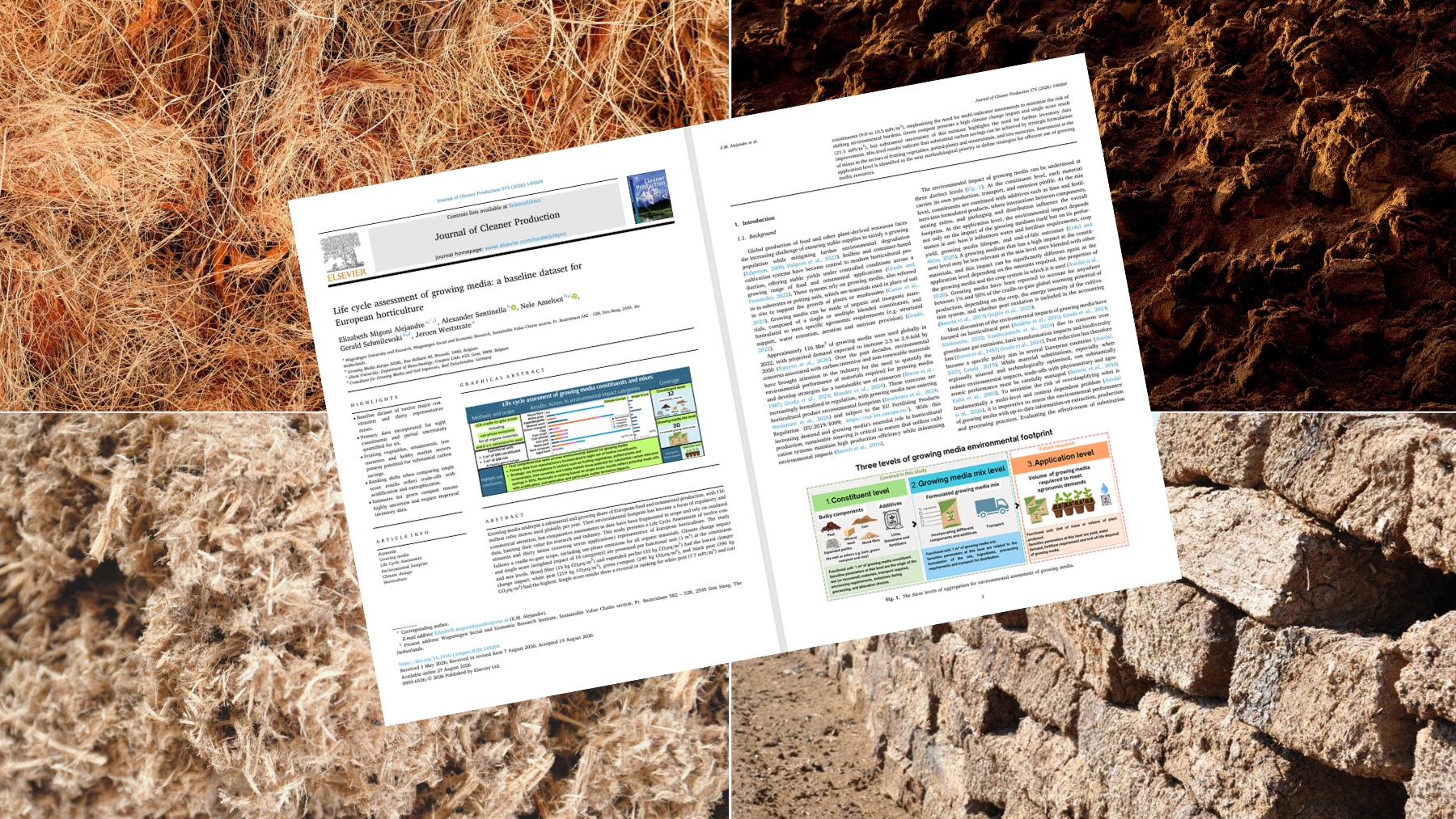
How sustainable is a growing medium? There is no simple answer to that question. A new study by Wageningen University & Research (WUR), published in the Journal of Cleaner Production, now provides the first scientifically robust and Europe-wide comparable dataset for the most important constituents used in growing media. Its key finding is clear: there is no single raw material that represents the most sustainable solution in every respect. What matters instead is the interplay between different constituents and their environmental impacts.
For the study, researchers assessed twelve major growing media constituents as well as 30 typical growing media mixes across seven horticultural application areas. In addition to peat, the analysis included materials such as wood fibre, coir products, bark, green compost, perlite and mineral wool. Rather than focusing solely on climate change, the researchers considered a total of 16 environmental impact categories. These included acidification, eutrophication, particulate matter, land use, as well as the consumption of water and other resources.
This broader approach leads to some particularly interesting findings. Wood fibre and expanded perlite, for example, show a comparatively low climate change impact. Peat, on the other hand, has higher CO₂ emissions, especially due to the assumed complete oxidation of its carbon content during the use phase. However, when the assessment looks beyond climate change and considers the overall environmental impact, the picture changes considerably in some cases. Coir-based constituents perform significantly better than peat in terms of climate impact but show higher impacts in other categories. The study thus highlights just how much environmental impacts can vary from one category to another.
Green compost is another good example of why a differentiated view is important. As a constituent made from organic residual materials, it may initially appear to be a particularly sustainable option. However, the study shows that factors such as the composting process, energy use and resulting emissions can have a significant influence on its environmental footprint. At the same time, the researchers explicitly point out that the available data for green compost is still subject to considerable uncertainty and needs to be improved further.
Of particular relevance to our industry is the study’s assessment of complete growing media mixes. The results show that targeted formulation can deliver significant reductions in the carbon footprint in a number of application areas. At the same time, a mix with a lower climate impact does not automatically perform better across all other environmental indicators. This is why the authors argue for an increasingly holistic and application-specific assessment of growing media.
Ultimately, it is not only the environmental footprint of an individual constituent that matters. Just as important is how well a growing medium performs in the actual crop. If a supposedly more sustainable raw material leads, for example, to reduced plant growth or to a higher demand for water, fertiliser or energy, the overall environmental performance of plant production may become worse. The next important step in research is therefore the application level: which growing medium is best suited to achieving a specific yield, how efficiently are water and nutrients used, and what environmental effects arise over the full cultivation cycle?
For the growing media industry, the study therefore provides an important new basis for future decision-making. It confirms that sustainability cannot be achieved simply by replacing one single constituent. Instead, the aim is to combine different raw materials intelligently, make use of their respective strengths, and keep both environmental impacts and horticultural performance in view.
Or, put simply: when it comes to sustainable growing media, things are rarely black and white. The best solutions emerge when environmental performance and plant growth are considered together.
You can find the study here: Life cycle assessment of growing media: a baseline dataset for European horticulture – ScienceDirect